Frequently asked questions
What conditions do we treat
We treat a wide range of musculoskeletal and sports-related conditions, including back and neck pain, middle-age hormone-related musculoskeletal injuries, shoulder rotator cuff conditions, hip, knee and ankle injuries, post-operative rehabilitation, running injuries, and persistent or recurrent pain. We work extensively with sailors, footballers, hockey and golf athletes, as well as active individuals of all ages. We also provide adolescent sports screening and management of growth-related injuries.
Do I need a GP referral?
No referral is required to see a physiotherapist. You can book directly with us.
A GP referral is only needed if you are claiming through Medicare (EPC Care Plans), DVA, or some workplace compensation schemes.
What happens during my first appointment?
Your initial consultation is a 45-minute assessment that includes a comprehensive review of your injury, movement patterns, and contributing factors. We take the time to understand your history and goals, review relevant imaging such as X-rays, ultrasounds, or MRI scans, and explain our findings clearly. Where appropriate, we communicate with your GP or specialist and develop a personalised treatment and rehabilitation plan tailored to you.
How long are appointments?
- Initial consultations: 45minutes
- Follow-up consultations: 30–45 minutes
This ensures adequate time for hands-on treatment, exercise prescription, and education.
Do you treat sports injuries?
Yes. Sports and performance physiotherapy is a core focus at K2 Health. We work with recreational athletes through to elite performers, combining physiotherapy, strength & conditioning, and clinical Pilates to support a safe and effective return to sport.
Our approach emphasises structured return-to-sport management, with appropriate progressive loading to ensure a smooth return to play and optimise long-term performance. End-stage rehabilitation focuses on sport-specific strengthening and conditioning to reduce the risk of re-injury.
We also incorporate proprioceptive and neuromuscular training to improve body awareness, movement control, skill execution, strength gains, and injury prevention — supporting athletes not just to return, but to perform at their best.
Do you offer Clinical Pilates?
Yes. Our Clinical Pilates sessions are physiotherapist-led and tailored to your injury, goals, and movement needs. They are ideal for injury rehabilitation, strength development, injury prevention, and improving movement control.
What should I expect at my first Clinical Pilates consultation?
You should expect a one-on-one, full physiotherapy assessment and examination that reviews both past injuries and your current presentation. This allows us to clearly understand your movement patterns, symptoms, goals, and any factors that may influence your rehabilitation or performance.
Your session will include early-stage, activation-based exercises and pain-modulation strategies to support safe movement and build confidence. This ensures a smooth and appropriate progression into Clinical Pilates.
From this initial consultation, we begin developing a tailored and highly specific Pilates program, personalised to your needs, goals, and physical capacity — forming the foundation for ongoing rehabilitation, strength development, and long-term injury prevention.
What is the K2 Clinical Pilates Pathway?
The K2 Clinical Pilates Pathway is a structured, physiotherapist-led progression designed to guide you from injury, pain, or movement limitation through to strength, control, and confident performance.
Stage 1: Physiotherapy Assessment & Foundations
Your journey begins with a comprehensive one-on-one physiotherapy assessment. This identifies injuries, movement restrictions, strength deficits, and contributing factors. Early rehabilitation focuses on pain modulation, activation, and restoring safe movement patterns. This will include at least one 1:1 sessions to ensure good technique is observed before progressing into a class.
Stage 2: Individualised Clinical Pilates (Rehabilitation Phase)
Based on your assessment, you commence Clinical Pilates with a personalised program targeting mobility, stability, and foundational strength. Sessions are closely supervised, with exercises modified and progressed according to your presentation and goals.
Stage 3: Progressive Strength, Control & Proprioception
As symptoms settle, your program advances to include progressive loading, proprioceptive training, and movement control. This phase improves body awareness, coordination, and resilience — key for injury prevention and performance.
Stage 4: Return to Activity, Sport & Performance
For active individuals and athletes, the pathway integrates sport- or activity-specific strengthening and conditioning. The focus is on preparing your body for the demands of daily life, work, or sport, ensuring a smooth and confident return with reduced risk of recurrence.
Stage 5: Long-Term Strength & Injury Prevention
Once goals are achieved, Clinical Pilates can continue as a long-term strategy to maintain strength, movement quality, and performance, supporting ongoing injury prevention and physical longevity.
Can you help after surgery?
Absolutely. We provide structured post-operative rehabilitation following procedures such as joint replacements, ligament reconstructions, and shoulder surgery. Your rehabilitation program is progressed safely and in line with your surgeon’s guidelines.
We work closely with your GP and specialist to ensure a comprehensive, collaborative approach to your care. This team-based model allows your rehabilitation to be individualised, closely guided, and appropriately progressed, supporting optimal recovery, safe return to function, and the best possible long-term outcomes.
Do you treat children and adolescents?
Yes. We regularly treat children and adolescents for sporting injuries, growth-related pain, and movement issues, particularly those involved in football, sailing, and other competitive sports.
Krystal Weir, Director of K2 Health and dual Olympian, works predominantly with adolescent athletes. She has a strong passion for supporting young people through critical growth and development periods, ensuring injuries are managed appropriately with careful load management and evidence-based rehabilitation.
Our focus is not only on short-term performance, but on developing resilient, healthy athletes for the long term — supporting young athletes to achieve their goals while protecting their bodies well beyond sport, into their future years.
What should I wear to my appointment?
Wear comfortable clothing that allows you to move easily and exposes the area being treated where possible (e.g. shorts for knee injuries, appropriate bra for female shoulder issues, sports tights for clinical Pilates ).
Do you accept private health insurance?
Yes. We accept all major private health funds. Claims can be processed on the spot using HICAPS. Coverage and rebates depend on your individual policy.
Where are you located?
We are located at the Royal Brighton Yacht Club, Bayside, Victoria. Free parking is available nearby, and our clinic offers a relaxed, welcoming environment overlooking the bay.
How do I book an appointment?
You can book online via our website or contact the clinic directly. If you’re unsure which appointment type or clinician to choose, our team is happy to help.
How do I find the clinic?
Enter through the main entrance of the Royal Brighton Yacht Club and walk through the club toward the beachside.
Once outside in the boat yard:
- On the northern side of the yard, you will see a large Physiotherapy sign. This is where all physiotherapy appointments and initial consultations are conducted.
- On the southern side of the yard, there is a set of stairs. This is where Clinical Pilates classes are held.
If you are new to K2 Health or attending an initial consultation, please make sure you go to the Physiotherapy side of the yard first.
If you’re unsure at any point, feel free to call us and we’ll guide you through.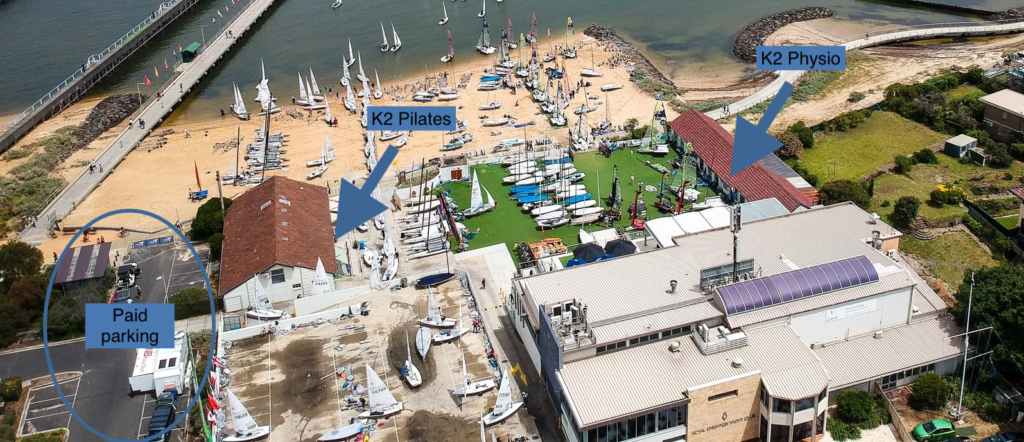
Parking at K2 Health
There are a number of parking options available near K2 Health. Free parking is available in designated Bayside resident zones, and metered parking is also available nearby.
For the best chance of finding free parking, we recommend trying Grosvenor Street and Normanby Street.
Please allow extra time during peak periods, particularly over summer, as parking can be limited due to beach and yacht club visitors.
If you’re running late or need help, just give us a call.
Can we use the gym at Royal Brighton Yacht Club?
Royal Brighton Yacht Club offers several levels of membership that include access to the gym facilities. For details on membership options, pricing, and access, we recommend speaking directly with Royal Brighton Yacht Club reception.
During physiotherapy consultations, your physiotherapist may use the gym facilities to demonstrate rehabilitation exercises or gym-based programming where appropriate.
K2 Health also provides a complimentary gym induction for Royal Brighton Yacht Club members. This is a short, 15-minute session designed to familiarise members with the gym equipment and sauna facilities and to ensure safe use of the space. Please note, this induction is a general safety session and does not include individualised rehabilitation or injury-specific assessment.
If you are a club member and would like tailored programming or individual guidance, please contact K2 Health directly and we can arrange an initial consultation to address your specific needs and goals.
Clinical Pilates Classes – Fees & Structure
Session Fees
- One-on-one Clinical Pilates (30 minutes): $98
- Group Clinical Pilates (one-off): $60
- Group Clinical Pilates (10-pass): $48 per session
Class Size & Structure
Clinical Pilates classes are run in small groups of up to four people per class. Each participant follows their own individualised program, which is written by your physiotherapist during your initial assessment and one-on-one Pilates sessions.
Getting Started – What’s Required?
Before joining a group class, a minimum of two sessions is required:
- An initial physiotherapy consultation, and
- A one-on-one Clinical Pilates session in the Pilates studio.
From there, progression into group classes is a shared decision between you and your physiotherapist, based on confidence, movement quality, and rehabilitation needs. Some clients may benefit from continuing with one-on-one sessions, while others are ready to progress into a class environment.
As a general guide, we recommend completing an initial consultation plus two one-on-one Pilates sessions to gain the most benefit before commencing a 10-pass group program.
Private Health Insurance Claims
Once your 10-pass is completed, we provide:
- The original invoice, and
- A completed 10-class attendance receipt
These can then be submitted directly to your private health insurer for claiming, in line with your individual policy.
Does my 10-pass have an expiry date?
At K2 Health, we pride ourselves on providing not only expert rehabilitation, but also fairness and flexibility — we understand that life can be busy.
Our 10-pass does not have a short-term expiry. However, it is valid for up to two years from the date of purchase. This allows you plenty of time to complete your sessions while maintaining a reasonable timeframe for your rehabilitation and care.
If you have any questions about your pass or need assistance scheduling your sessions, please contact us and we’ll be happy to help.
What should I bring to my appointment?
Please bring any relevant imaging (X-rays, MRI or ultrasound reports), specialist letters, or post-operative protocols that may assist with your assessment and rehabilitation.
If applicable, bring your private health insurance details, EPC referral form from your GP, and your Medicare card.
Please wear comfortable clothing and appropriate footwear that allows you to move easily. For lower limb or foot-related injuries, bring any footwear you commonly wear (e.g. runners, football boots, work shoes) to allow assessment in real-world conditions.
Balance Programs
At K2 Health Physiotherapy & Pilates, we provide individualised balance programs designed to support balance changes that occur as part of the natural ageing process. Programs are tailored to each person and may include lower-limb strength training, core stability and strength, proprioception retraining, and static and dynamic balance challenges.
Our approach is guided by the latest research and best-practice implementation to help reduce the risk of falls and improve confidence with everyday movement. We utilise a range of validated outcome measures to track progress and ensure programs remain safe, effective, and goal-focused.
Bone Health Osteoporosis Programs
At K2 Health Physiotherapy & Pilates, we provide individualised exercise programming for bone health, including the management of osteopenia and osteoporosis. Our programs are designed using the latest research and best-practice guidelines to safely stimulate bone adaptation.
Training focuses on applying appropriate load and impact to encourage healthy bone remodelling — supporting the balance between osteoblast (bone-building) and osteoclast (bone-resorbing) activity. The goal is to develop stronger, more resilient bones that can better withstand the demands of daily life and reduce fracture risk.
All programs are tailored to the individual, medically informed, and progressed safely under physiotherapist supervision.
Cancer Programs
At K2 Health Physiotherapy & Pilates, we provide individualised rehabilitation programs both before and after cancer treatment. Our approach recognises the complex and multifaceted challenges of cancer rehabilitation, and the physical, emotional, and mental load experienced not only by the patient, but also by their family.
Programs are carefully tailored to address each person’s specific symptoms, physical capacity, strength, fatigue levels, and immune health, with close consideration of the impacts of cancer treatment. Our goal is to support safe recovery, rebuild strength and confidence, and help individuals return to meaningful daily activities in a supportive and understanding environment.
Musculoskeletal injuries
At K2 Health Physiotherapy & Pilates, we deliver individualised rehabilitation programs for both musculoskeletal injuries and tendon health. Our approach is centred on progressive loading, tailored to the specific dysfunction, tissue capacity, and goals of each individual.
Rehabilitation is guided through clear stages — from initial activation and capacity building, through to advanced, high-level rehabilitation and return to activity or sport. We place strong emphasis on education, ensuring patients understand how and why load is progressed safely over time.
Our experienced physiotherapists bring a depth of knowledge informed by the latest research and real-world clinical experience, gained through many years of physiotherapy practice across a wide range of conditions and performance levels.
How many classes should I do a week?
For most people, 1–2 Clinical Pilates classes per week is ideal to build strength, improve movement control, and support injury rehabilitation.
Your physiotherapist may recommend 2–3 sessions per week during periods of active rehabilitation, return to sport, or when managing more complex or persistent conditions. The exact number will be tailored to your goals, injury history, and overall training load.